

Cataract Treatment
Learn about cataract evaluation and treatment options available at Thakur Eye Hospital, Karnal.
Advanced Cataract Evaluation & Treatment
Are you tired of issues like blurry vision, glare, and difficulty seeing at night?
If yes, this might be an early sign of cataract. Do not stress; if you are facing such issues, at Thakur Eye Hospital, we are experts in advanced eye surgery for cataract and other cataract treatments that will help you regain clear and comfortable vision.
All you have to do is…
What is Cataract Eye Disease?
Cataract is a very common eye condition that causes cloudiness in the natural lens of the eye. This is usually caused when proteins in the eye break down and clump. This, in turn, restricts light from reaching the retina, causing blurred, hazy vision.
In most cases, the condition develops slowly over time, but in some cases, the progression is quite rapid, causing serious issues and interrupting day-to-day work.
What leads to Cataract?
Cataract eye disease can develop due to several reasons, including:
- Aging – The most common cause. As we grow older, the eye’s lens naturally becomes less clear.
- Diabetes – High blood sugar levels can speed up cataract formation.
- Prolonged exposure to sunlight (UV rays) – Long-term UV exposure damages the lens proteins.
- Eye injury or trauma – Injury to the eye can lead to early cataract development.
- Long-term use of steroids or certain medications – These can affect lens clarity.
- Smoking and alcohol consumption – Both increase the risk of cataracts.
- Genetic factors – Cataracts can run in families or be present from birth (congenital cataract).
- Other eye diseases or surgeries – Conditions affecting the eye may trigger cataract formation.
Symptoms of Cataract
- Blurry or cloudy vision
- Increased glare from lights, especially while driving at night
- Difficulty seeing in low light or at night
- Halos around lights
- Seeing Yellowish colours
- Double vision
- Frequent change in spectacles
- Reduced clarity
- Seeing halos around lights
These symptoms usually develop gradually, which is why many people ignore them in the early stages.
Types of Cataract Eye Disease
Cataract is often classified on the basis of its appearance in the eye lens.
Nuclear Cataract
This is the type of cataract that appears in the central part of the natural eye lens, usually a result of ageing. As a result, one might experience blurred vision with a yellow or brownish tint, making it difficult to differentiate between colours.
Cortical Cataract
Cortical Cataract often begins at the outer edge of the eye lens, called the cortex. This gradually extends towards the centre, forming white wedge-shaped streaks. This type of cataract eye disease causes glare and light sensitivity, making it tough to judge distances while driving and even harder to walk on uneven surfaces.
Posterior Subcapsular Cataract (PSC)
This form of cataract forms at the back of the eye lens, which usually progresses faster than other types of cataract. PCS mostly affects near vision, causing reading difficulty with glare or halos around light. This type is common in diabetic people or in those who use steroid medication for a long period of time.
Congenital Cataract
Congenital cataracts are present at birth or develop during early childhood. This type of cataract is a result of infection or any medical condition that occurred during pregnancy. In this situation, it is critical to get an early diagnosis as any kind of delay can interfere with normal vision development or lead to permanent vision issues.
Secondary Cataract Eye Disease
Secondary cataracts can develop after eye surgery or as a result of other eye conditions. They may also be associated with systemic diseases like diabetes or prolonged use of certain medications. Although they cause vision to become cloudy again, they are usually treatable with a simple, quick laser procedure.
Cataract Diagnosis & Tests
Eye specialists perform a comprehensive eye examination to assess lens clarity, overall eye health, and the impact of cataract on vision. At Thakur Eye Hospital, we perform the following tests to help determine the severity and progression of the condition:
Visual Acuity Test
This test measures the sharpness of your vision by using eye charts held at different distances. This is done to see whether the cataract is affecting daily vision.
Slit-Lamp Examination
Uses high magnification to examine the front parts of the eye, including the lens. This test helps identify the location, density, and pattern of lens clouding.
Retinal Examination
Performed after dilating the pupils to examine the retina and optic nerve. This helps us ensure there are no underlying retinal conditions affecting vision.
Tonometry
Measures intraocular pressure to rule out pressure-related eye diseases like glaucoma that might be the cause of cataract.
Refraction Test
Determines whether glasses or contact lenses can temporarily improve vision before surgery is considered.
Cataract Treatment Options
Non-surgical visual support: Updated glasses, brighter lighting and anti-glare strategies may temporarily improve visual function in early cataract, but they do not remove or reverse the cataract.
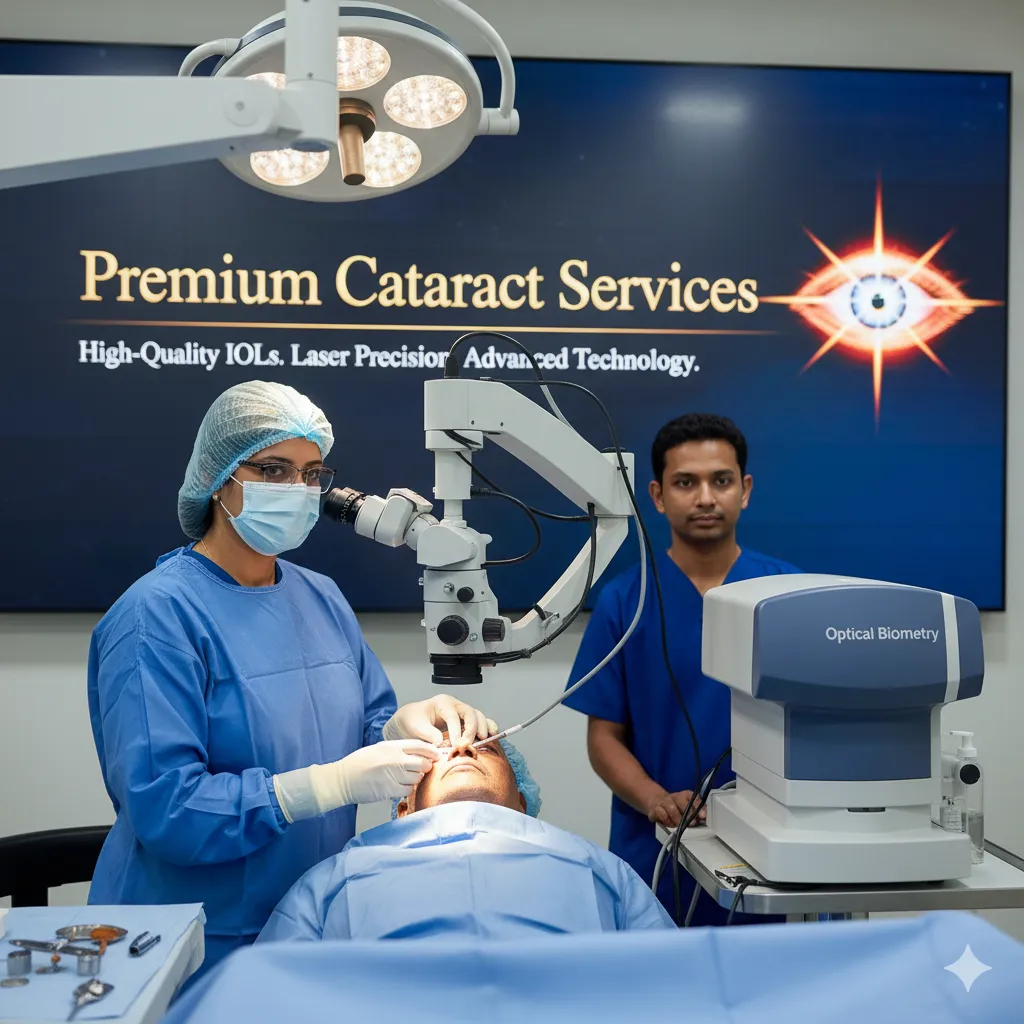
Cataract surgery: When cataract significantly affects vision or daily activities, surgery is the established treatment. The cloudy natural lens is removed and replaced with an artificial intraocular lens (IOL). The timing of surgery, surgical technique and IOL are selected after examination and biometry according to the patient’s eye health and visual needs.
Lifestyle and eye health: UV protection, smoking cessation, good nutrition and control of conditions such as diabetes support general eye health, but they do not reverse an established cataract.
Types of Eye Surgery for Cataract
Phacoemulsification (Micro-Incision Cataract Surgery): Phacoemulsification is a commonly used modern cataract-surgery technique. Ultrasound energy is used to break up the cloudy natural lens, which is removed through a small incision before an artificial intraocular lens is implanted. Anaesthesia, postoperative comfort and recovery vary according to the patient and procedure.
Femtosecond Laser-Assisted Cataract Surgery (FLACS): A femtosecond laser can perform selected steps of cataract surgery, such as certain corneal incisions, opening the lens capsule and lens fragmentation. The surgeon remains responsible for performing and controlling the operation. Whether FLACS offers an advantage for an individual patient depends on the eye and the planned procedure.
Extracapsular Cataract Extraction (ECCE): ECCE removes the cloudy lens through a larger incision while leaving the back part of the lens capsule in place to support the IOL. It may be selected for very dense or complex cataracts when another technique is less suitable.
Cataract Eye Surgery Procedure
Below are the general steps followed for cataract surgery at Thakur Eye Hospital. The exact plan is individualized after examination.
Pre-surgery assessment: The eye is examined and measurements are taken to select an appropriate intraocular lens based on ocular measurements and the patient’s visual requirements.
Anaesthesia: Anaesthesia is selected according to the patient and procedure. Topical or local anaesthesia is commonly used, and additional sedation may be considered when clinically appropriate.
Lens removal: In phacoemulsification, ultrasound energy is used to fragment the cloudy lens so it can be removed through a small incision.
IOL insertion: The selected artificial intraocular lens is implanted to replace the cloudy natural lens.
Recovery: The patient receives postoperative instructions and follow-up advice. Recovery and visual improvement vary between individuals.
Cataract Eye Surgery Aftercare
- Use prescribed eye drops regularly to prevent infection and reduce inflammation.
- Avoid rubbing or pressing the operated eye.
- Wear protective sunglasses outdoors to shield the eye from dust and bright light.
- Avoid heavy lifting, bending, or strenuous activities for a few days.
- Keep the eye clean and follow all follow-up visit schedules as advised by your eye doctor.
Cataract eye surgery after effects
Slight discomfort, blurred vision during the healing phase, sensitivity to light, and dry eyes are some of the common side effects of cataract surgery.
Some rare complications that might occur include infection or pressure changes. However, these conditions are treatable.
Cataract prevention tips
- Wear sunglasses to reduce sun damage and protect your eyes from UV rays.
- Eat food that are rich in vitamins A, C, and E
- Quit smoking if you do
- Control health conditions such as diabetes, hypertension, and other systemic diseases.
- Get regular eye checkups to track the progression.
FAQs About Cataract
At what age do cataracts usually develop?
Cataracts commonly develop after the age of 50, though they can appear earlier or even be present at birth.
Will I need glasses after cataract surgery?
This depends on the type of intraocular lens implanted; some patients may still need glasses for certain activities.
Can cataracts come back after surgery?
No, cataracts do not return, but some patients may develop posterior capsule opacification, which can be easily treated with laser.
Can both eyes be operated on at the same time?
No, the cataract surgery is often performed one eye at a time.
Will the cataract surgery be covered by insurance?
Whether or not the surgery is insured depends on the type of policy & type of Intraocular lens.
How soon can I return to normal activities after surgery?
Most patients can resume light daily activities within a day or two, following the doctor’s advice.
Can I use a mobile phone or watch TV after cataract surgery?
Yes, you can use digital screens in moderation, but taking breaks is recommended during early recovery.
Are there any dietary restrictions after cataract surgery?
There are usually no strict restrictions, but a healthy, balanced diet supports faster healing.
What happens if cataract surgery is delayed for too long?
Delaying surgery can lead to severe vision loss and may increase surgical difficulty in advanced stages.
Is cataract surgery suitable for diabetic patients?
Yes, diabetic patients can safely undergo cataract surgery with proper evaluation and controlled blood sugar levels.